

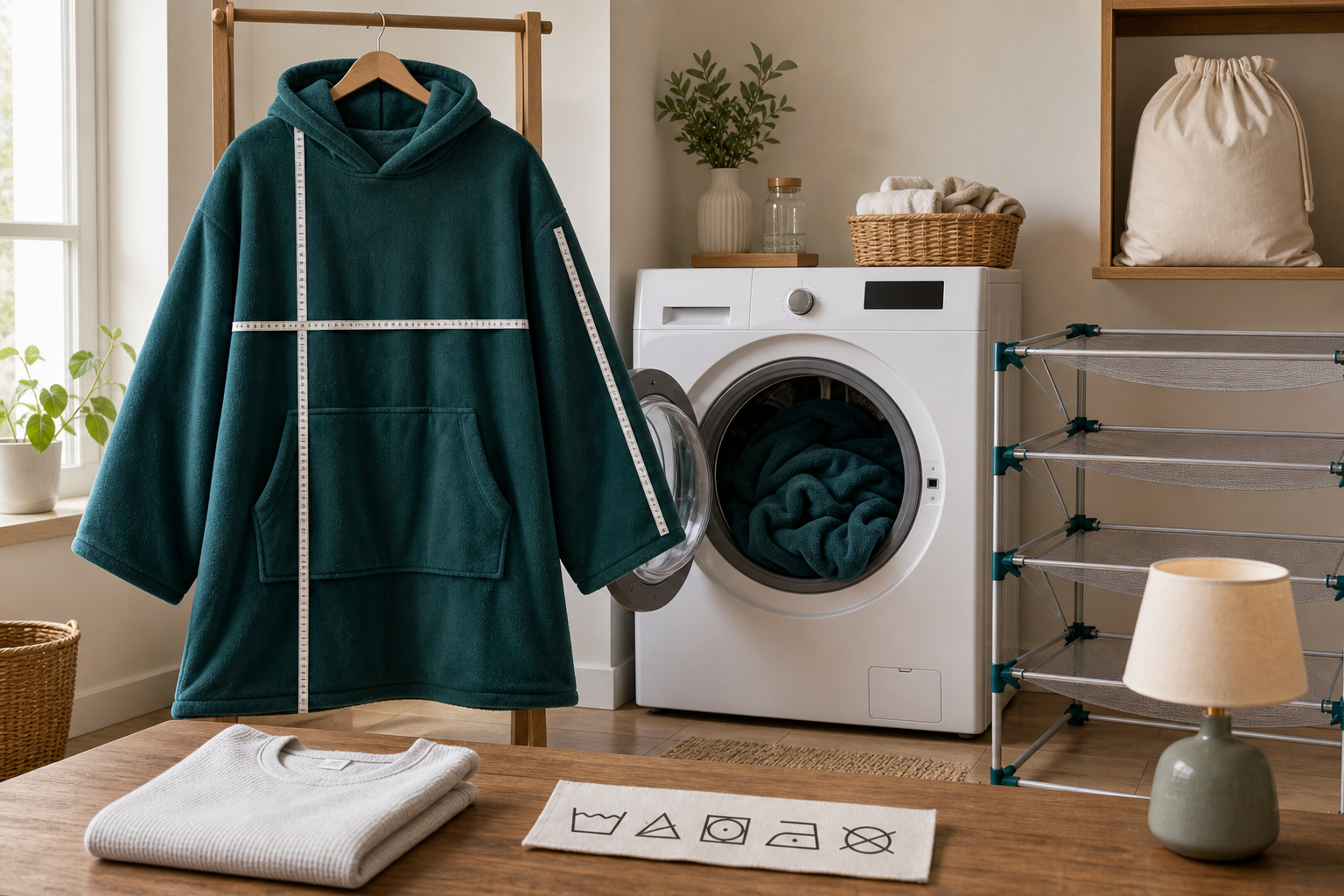
The short answer: size a blanket hoodie by its actual chest, body, shoulder and sleeve measurements—not by “one size” alone. Compare those dimensions with a roomy garment you own, then allow space for the base layers you plan to wear. Before laundering, read the sewn-in care label, confirm your machine can handle the dry and wet bulk without crowding, and use only the specified wash and drying methods. Store it completely clean and dry in a breathable container away from heat, flame and pests.
A wearable blanket is deliberately larger and bulkier than an ordinary hoodie, so its fit, laundry load and storage volume need a different plan. This Soco Hoodie guide does not assign a warmth rating, fibre blend or flame resistance unless the exact product or physical label provides one.
Blanket-hoodie sizing: measure the garment, not the size name
| Measurement | How to compare | Why it matters |
|---|---|---|
| Chest width/circumference | Compare the listing method with a roomy garment laid flat | Determines layering and arm movement |
| Body length | Measure from the stated shoulder or neck point to hem | Affects stair, chair and walking clearance |
| Shoulder | Check whether the design is intentionally dropped | Oversized shoulders change sleeve position |
| Sleeve | Use the same start point as the size chart | Long cuffs can interfere with cooking or tasks |
| Hem/waist width | Confirm room to sit and bring knees up comfortably | Blanket hoodies often narrow or curve toward the hem |
The active Multi Patterned Fleece Blanket Hoodie and Long and Warm Solid Fleece Oversized Blanket Hoodie listings currently show one-size measurement tables, including chest, length, shoulder, waist and sleeve values. Verify the current table and its units before ordering; “one size” does not mean one proportion suits every wearer.
Use painter's tape or a folded sheet to preview body width and length. Sit, stand, reach, walk and climb a step in the garment you are comparing. A hem that feels cozy on a sofa may be too long near stairs, mobility aids or rolling chair wheels.
Plan layers without trapping movement
Decide whether the blanket hoodie will go over sleepwear, a T-shirt, thermal base layer or sweatshirt. Measure the full layered outfit, then compare it with the product dimensions. Check that elbows bend, arms lift, the hood turns with the head, and the neckline does not press or pull backward.
More layers do not create a standardized warmth rating. Comfort depends on room temperature, activity, air movement, moisture, individual needs and the exact textile. If you feel overheated, dizzy, damp or restricted, remove a layer and move to a safer environment. Wearable blankets are not medical warming devices or outdoor protective equipment.
Choose length and features for the activity
The Cool and Comfy Fleece Oversized Blanket Hoodie listing describes elastic sleeves and a length intended not to drag, while the Warm Half Zipper Blanket Hoodie adds a half-zip format. Treat those as listing-specific details. A zipper needs its own inspection for smooth operation and fabric caught in the teeth.
For reading or television, pocket and hood placement may matter most. For desk work, make sure cuffs stay clear of keyboards and drinks. For walking around, check floor and stair clearance. Do not cook over an open flame, handle hot burners, or work beside sparks while wearing loose, bulky sleeves.
Fire and heater safety
A cozy textile should never be assumed flame-resistant. Keep blanket hoodies away from candles, fireplaces, cigarettes, stovetops and other ignition sources. The U.S. Consumer Product Safety Commission promotes a three-foot clearance around space heaters; maintain that clear zone for people, clothing, blankets, furniture and other combustible materials.
- Do not drape the hoodie over a heater, radiator or heated appliance to warm or dry it.
- Do not block a heater's intake or outlet while wearing a long, loose garment nearby.
- Turn off and unplug portable heaters when unattended or sleeping, following the heater maker's directions.
- If the garment contacts flame or high heat, stop use and inspect for melting, charring or weakened fibres.
- Do not treat “fleece,” “sherpa,” “flannel” or “warm” in a title as a fire-performance certification.
How to wash a bulky blanket hoodie
Start with the care label. The FTC's Care Labeling Rule requires covered apparel manufacturers and importers to provide regular care instructions, including washing or dry-cleaning and relevant drying or warning information. A product title does not replace that label.
- Inspect first. Empty the pocket, remove debris, close a zipper if the label recommends it, and repair loose seams before washing.
- Check capacity. Place the dry garment loosely in the drum. It needs room to move; wet bulky textiles become heavier. Follow the washer maker's load limits.
- Balance the load. Do not force a single bulky item into a machine that cannot distribute it. Stop if the washer bangs, walks or cannot spin evenly.
- Use the stated cycle. Follow the exact temperature, detergent, bleach and agitation directions. Do not assume fleece permits hot water.
- Rinse fully. Residual detergent can remain in thick piles or linings; use only options permitted by the garment and machine instructions.
- Remove promptly. Support the wet garment with both hands rather than pulling one sleeve or the hood.
If the garment exceeds the household machine's capacity, use an appropriately sized machine or professional cleaner consistent with the label. Hand-washing a very bulky item can create lifting and drying problems; the wet weight may be much greater than expected.
Dry completely without guessing about heat
Use only the drying method and temperature on the label. High heat can change pile, elastic, trim, zipper components or dimensions. If tumble drying is allowed, do not overfill the dryer; airflow matters. If flat or line drying is required, support the garment's weight and reshape it rather than hanging a heavy wet hoodie from one point.
Check the hood, cuffs, pocket corners, lining and seams for retained moisture. A surface can feel dry while thick sections remain damp. Do not store until the entire garment is dry and at room temperature. Never accelerate drying on a space heater, stove or fireplace.
Off-season storage
- Clean according to the label so food, body oils and stains do not sit for months.
- Dry completely and inspect for damage.
- Fold without crushing the hood or zipper and avoid a tight crease in the same location year after year.
- Use a clean, breathable storage bag or container suited to the environment.
- Store in a cool, dry interior location away from direct sunlight, heaters, damp basements and hot attics.
- Inspect periodically for moisture, odour, pests or colour change.
The Original Sherpa Fleece Blanket Hoodie is another live style to compare, but “sherpa” in the title does not by itself verify fibre percentages or a laundering method. Read the selected product page and physical label.
Frequently asked questions
Does one size fit everyone?
No. Compare the listed garment measurements and measurement method with the intended wearer and planned layers.
Can I wash a blanket hoodie with towels?
Only if the care labels, colours and machine capacity are compatible. Bulky mixed loads can become unbalanced or fail to rinse and dry evenly.
Can I dry it on a radiator?
No. Keep loose textiles off heaters and radiators. Follow the garment's stated drying method.
Is fleece flame-resistant?
Do not infer flame resistance from the word fleece. Only a verified label or certification for the exact item can support that claim.
How do I know it is fully dry?
Check thick, doubled areas such as the hood, pocket, cuffs and seams, not just the outer surface. Let it cool before checking and storing.
Bottom line
Treat an oversized blanket hoodie as a bulky garment: measure its real dimensions, allow planned layering space, maintain safe floor and heat clearance, and use a washer and dryer that can handle the volume. Care and store it according to the exact label, without assuming fibre, warmth or flame performance.